
We offer customized packages to Colombia. Contact us for a quote. |
Colombia Tours Colombia tours are becoming fashionable now, after so many years of being off the beaten path. The country has a lot to offer:
Click to set custom HTML
|
|
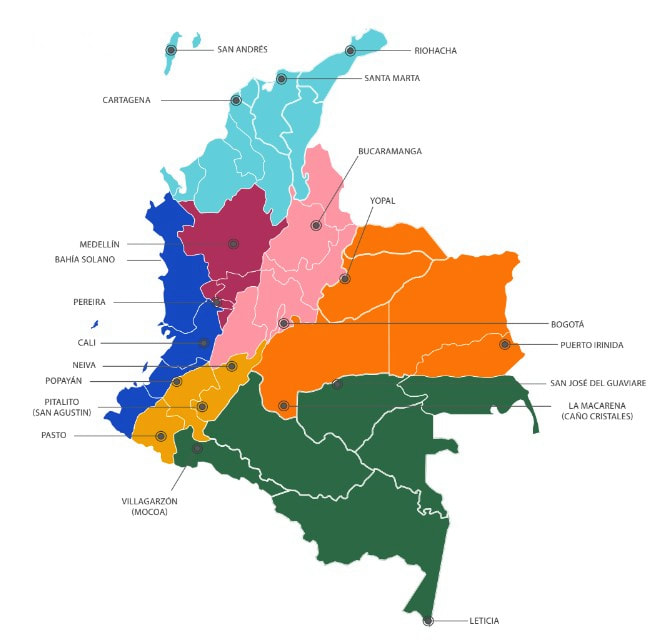
In general, Colombia can be divided into 5 major regions:
Caribbean Coast The Caribbean Coast of Colombia has been a popular destination for decades. The region´s tropical beaches, wonderful climate and colonial cities, such as Cartagena with its colorful houses, attract visitors from all over the world. Besides Cartagena, also the beach town of Santa Marta, the exotic islands, Tayrona National Park – perfect for trekking and relaxing, and the culturally rich area of Guajira are destinations that should not be missed when visiting the Caribbean Coast of Colombia. Pacific Coast Little visited by tourists, Colombia´s Pacific Coast is definitely an undiscovered gem. This is where tropical forests transform into white beaches and humpback whales pass by during the summer months. Gorgona Island, with its tropical forest and diversity of animal species, is a heaven on earth and one of the highlights of the region. This coastal area has more than stunning landscapes and wildlife; indigenous communities offer interesting insights in the traditional cultures. Also Cali, Nuqui and Bahia Solano. Utría National Natural Park is perhaps the most accessible place to appreciate the region's high biodiversity, including turtles, birds, armadillos, butterflies and frogs. Andes Mountains In the Andes, one finds Colombia’s capital, Bogota, and the historically rich city Medellin. On top of these vibrant cities, the Colombian mountains hide many more treasures. One of them is the Coffee Triangle, where the world´s top quality coffee is produced and your clients can learn about the process of making coffee. Other top destinations are El Cocuy National Park, with its glaciers and snow-capped peaks, and charming colonial towns like Villa de Leyva, Barichara and Guatape Orinoquia - Los Llanos The region Los Llanos (the plains) is located in the east of the country at an altitude between 500 and 700 meters (1600 and 2300 feet). This area is filled with wonderful off-the-beaten-path destinations, such as the colorful river of Caño Cristales and Chiribiquete, the largest National Natural Park in Colombia (only available for overflights at the moment). It is the land of plains, cattle and cowboys, where you can get to know an authentic country lifestyle and maybe even see an anaconda, a giant anteater, giant otter, white-tailed deer, puma and the spectacular jaguar among other fauna. Amazon Rainforest A large part of Colombia is tropical rainforest, but the jungle remains to be a largely unexplored area. From Leticia, located in the south of the country, travelers can visit Monkey Island to spot squirrel monkeys, and Tarapoto Lake for its river dolphins, among many other wonderful destinations. The people of the Amazon communities of this area are happy to share their unique way of live with visitors and contribute to once-in-a-lifetime experiences. Also newly promoted areas like Guaviare, Mavecure Hills, Vaupes and Putumayo are great for Colombia amazon tours. For more information see Amazon Tours in Colombia . And all over the country, you can find great birdwatching opportunities, since Colombia has more species than any other country. It is difficult to put everything on a website, but we list many sample itineraries to show some possible options for you and then we can prepare a custom itinerary to suit your interests. Ask Us About A trip to Colombia"Yes, sadly we are back! All went really well and all 3 of us thoroughly enjoyed the trip - Colombia is a wonderful country. The organisation was faultless and, with quite a bit of travelling between venues, all went very smoothly - Edwin had it all taped. We'll have to start thinking about the next one now!" Richard |
As of this April, 2023, there is no more proof of Covid vaccination or negative test result required to enter Colombia! This leaves us with only one Covid-related entry requirement:
TIME
All of Colombia is on the same time zone, five or six hours behind Greenwich Mean Time depending on the season. ELECTRICITY All of Colombia uses 110 volt electricity with US type flat two pin plugs. It is best to bring an adapter. CLIMATE Colombia is located near the Equator which allows for relatively minor climate variations over the year. Temperatures vary according to altitude creating different climate zones: Warm: temperatures above 24°C in altitudes lower than 1.000 meters, which comprises 80 % of the territory. Tempered: temperatures between 17°C and 24°C above 1.000 and 2.000 meters. Cold: temperatures between 12°C and 17°C above 2.000 and 3.000 meters. Páramo (altiplano): temperatures below12°C with altitudes above 3.000 meters. Altitudes also generate differences in temperature between day and night. Clearly, as the altitude increases, so does the difference in climate. There are no variations in the low lands where days and nights are warm. Colombia experiences two seasons: the “dry” season or summer and the “rainy” season or winter. The length of the seasons and the amount of rain vary according to the regions. The Andes, for instance, have two dry and two rainy seasons a year. The main dry season stretches from December to March and July and August are rainy as well. The Llanos have a dry season from December to March and are rainy over the rest of the year. There is no uniform climate in the Amazon which is quite rainy all year round. INTERNAL TRANSPORTATION El Dorado Airport (Bogotá) is the main international hub and has connections to the most important tourist areas and cities. Most frequent air routes are Cartagena, San Andrés, Santa Marta, Riohacha, Cúcuta, Monteira, Medellín, Cali, Pasto, Neiva, Pereira, Armenia, Valledupar and Leticia. Main domestic airlines are Avianca, Aerorepública, Satena, Aires, Saerca and Ada. Colombia has an extensive internal road network which is relatively safe and in good condition. Nevertheless, in some areas, air transport is preferable. Numerous bus connections between the various cities offer night routes. PRICES
The prices shown are without the extra 19% VAT on top as foreign tourists do not have to pay this tax. We can therefore only guarantee this price if we have copies of the passengers´ passports as proof of their nationality. DOCUMENTS AND VISAS To enter Colombia, you need a valid passport. A visa is not required for stays up to 90 days but is required for longer stays and must be requested in the respective Colombian consulate. It is also possible to request a 30 day extension from the DAS (Departamento Administrativo de Seguridad). CURRENCY AND EXCHANGE RATES The unit of Colombian currency is the Colombian Peso. The notes are in denominations of $2.000, $5.000, $10.000, $20.000 and $50.000; and the coins are $20, $50, $100, $200 and $500 The exchange rate fluctuates from day to day and has the U.S. dollar as the official reference rate. Payment is made on the basis of the official daily rate, after discounting commissions and services, which vary between 2 and 3%. We recommend changing only in authorized money exchange bureau or “casas de cambio”, in banks and hotels and never on the street. The USA dollar is the easiest currency to exchange. Traveler’s checks are rarely used as it is difficult to change them outside of Bogotá. The most convenient brand to use is American Express, but they need to be changed in a bank and these have limited bank hours. Major credit cards are widely accepted in most important tourist destinations where Visa and Master Card can also be used in cash machines or “cajeros automáticos” to withdraw cash. IMMUNIZATION Most immunizations are not necessary to travel to Colombia. We nevertheless recommend asking your physician or a specialized center for more detailed information. The Minister for Health has officially stated that the Yellow Fever vaccine is NOT mandatory to travel within Colombia. The vaccine is only required for travellers coming from or returning to Angola, Democratic Republic of Congo, Uganda and Brazil. These travellers will be required to produce an International Certificate for the Yellow Fever vaccine upon arrival or departure from the country. However, it is still recommended that travellers who will be entering high-risk areas receive the vaccine by a minimum of 10 days before their trip. We suggest that travellers receive the vaccine if they will be visiting the following touristic destinations: Riohacha, Cabo de la Vela, Santa Marta, Aracataca, Lost City, Parque Nacional Natural Tayrona, Amazonas, Nuquí, Caño Cristales, Cerros de Mavecure |
